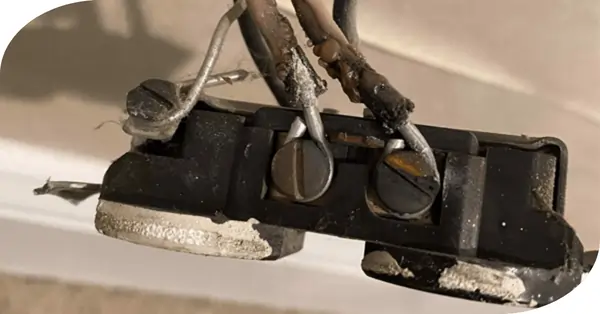
If you’ve ever had a thunderstorm roll through and then found your microwave clock blinking, your garage door opener acting possessed, or worse, a dead HVAC control board with a blown fuse the next morning, you may have experienced a power surge. Most homeowners never think about whole-house surge protection until something gets fried. By then, what could have been a relatively inexpensive preventive measure has turned into an insurance claim or an expensive repair bill.
I’ve installed a lot of these over the years, in a lot of different panels, for a lot of different reasons. Here’s what a whole-house surge protector actually does, whether it’s worth it, and (because this is the part nobody explains clearly) which one you actually need based on the panel you already have.
What a Whole-House Surge Protector Actually Does
A whole-house surge protector, technically called a surge protective device (SPD), is installed at or near your electrical panel and helps protect equipment throughout your home: your HVAC system, refrigerator, washer and dryer, and anything else hardwired into your electrical system, not just the stuff plugged into an outlet.
Most of these devices work using components called metal-oxide varistors (MOVs). Under normal conditions, an MOV has very high resistance and has virtually no effect on the circuit. When a surge hits and voltage rises beyond a certain level, the MOV’s resistance drops rapidly, creating a low-impedance path that limits the voltage across the protected conductors. Once the surge passes, the MOV returns to its normal high-resistance state, although repeated or severe surges can gradually degrade it.
Think of it as a pressure relief valve that only opens when there’s too much pressure, then closes again.
A Quick Correction to a Common Myth
You’ll see a lot of surge protector marketing (and a lot of well-meaning advice online) describe this as “diverting the surge to ground,” like the extra electricity gets dumped into the earth and disappears. That’s not quite right, and it’s worth understanding why, because it also explains why grounding hardware and surge protection are different things doing different jobs.
Electricity doesn’t have a destination called “ground.” Electrical current flows in a complete path, and the source of a surge determines how that current behaves.
When an SPD operates, it creates a low-impedance path between conductors, limiting the voltage difference that connected equipment experiences. Depending on the surge, its origin, and the SPD’s internal configuration, surge current may flow between line, neutral, and grounding conductors.
The important distinction is that the SPD isn’t simply dumping electricity into the dirt. It’s limiting transient overvoltages by providing a path for surge current.
The ground rod at your service (your grounding electrode) does something different. Per NEC 250.4(A)(1), the grounding electrode system helps limit voltage imposed by lightning, line surges, or unintentional contact with higher-voltage lines, while also stabilizing the system’s voltage relative to the earth.
It is explicitly not intended to serve as the effective ground-fault current path. The Code is direct about this in 250.4(A)(5).
The earth’s resistance is generally too high to carry sufficient fault current to operate an overcurrent protective device. A 120-volt fault through a hypothetical 25-ohm earth-return path would produce only about 4.8 amps, even before accounting for other impedance. That’s nowhere near enough to trip a standard 15- or 20-amp breaker.
Clearing a ground fault safely is the job of the effective ground-fault current path, which includes the equipment grounding conductor (your green wire, conduit, or other qualifying conductive path), along with the necessary bonding connections back to the source.
This low-impedance metallic path allows sufficient fault current to flow so that the breaker or fuse can operate.
So, three different components, three different jobs:
- Equipment grounding conductor: provides part of the effective ground-fault current path, allowing protective devices to clear ground faults and reducing shock hazards.
- Grounding electrode system (ground rods, etc.): helps limit certain overvoltages and stabilize the electrical system relative to earth; it is not the effective ground-fault current path.
- Surge protective device: limits transient overvoltages by conducting surge current between the conductors it is designed to protect.
These components perform different but complementary functions. Proper grounding, bonding, overcurrent protection, and surge protection all contribute to a safer electrical system.
(A quick note on why this misconception is so common: even the NEC’s grounding language gets misread this way constantly. If you want to go deep on it, Mike Holt has an excellent, free breakdown of these fundamentals worth watching.)
So, three different components, three different jobs:
- Equipment grounding conductor: clears faults, protects you from shock.
- Grounding electrode (ground rod): limits overvoltage from nearby lightning or utility anomalies; not fast enough to clear a fault.
- Surge protective device: clamps a transient spike in real time and routes that current back toward its source, mainly via the neutral.
None of them does another one’s job. All three working correctly is what actually keeps your home’s electrical system, and the people in it, safe.
(A quick note on why this misconception is so common: even the NEC’s grounding language gets misread this way constantly. If you want to go deep on it, Mike Holt has an excellent, free breakdown of these fundamentals worth watching.)
Is It Worth It?
Short answer: yes, for most homes, and the Code increasingly agrees.
Since the 2020 NEC (Section 230.67), a Type 1 or Type 2 surge protective device has been required for services supplying dwelling units. The 2023 NEC expanded surge protection requirements to certain additional occupancies, including dormitory units, hotel and motel guest rooms, and patient sleeping rooms in nursing homes and limited-care facilities. These additional requirements are addressed in other Code sections.
Keep in mind that NEC adoption varies by jurisdiction, so the applicable requirements depend on your local electrical code.
But code minimums aside, here’s the practical case: modern homes are loaded with sensitive electronics that older homes simply didn’t have.
Smart thermostats, variable-speed HVAC boards, induction ranges, EV chargers, home networking gear, etc. Many of these systems contain sophisticated electronic components that can be vulnerable to transient overvoltages.
A surge from a nearby lightning strike, utility switching event, or even equipment operating within your own home can damage expensive electronics.
A whole-house SPD is an inexpensive way to reduce that risk. It provides a first line of defense for equipment throughout your electrical system instead of relying entirely on a patchwork of plug-in surge protectors that most people don’t even bother using consistently.
Type 1 vs. Type 2 vs. Type 3: What’s the Difference?
This classification tells you where a device is permitted to be installed and the testing requirements it must satisfy, NOT simply how good it is.
- Type 1: permitted on the supply side or load side of the service disconnect, depending on the installation. These are commonly used at service entrances and other locations where their listing permits.
- Type 2: installed on the load side of the service disconnect, typically at the main electrical panel or a distribution panel. This is a common choice for residential whole-house protection.
- Type 3: point-of-use protection, such as the plug-in surge protector you probably already know. These devices are generally evaluated for installation at least 30 feet of conductor length from the service panel, subject to their listing and installation instructions. They work best as a supplement to upstream Type 1 or Type 2 protection, NOT as a replacement.
Think of it as layered defense: Type 1 and Type 2 devices provide protection at the electrical distribution level, while Type 3 devices add another layer of protection closer to sensitive electronics.
Whole-house protection doesn’t mean you should throw out your surge-protecting power strips. It means the strips finally have backup.
Redundancy in safety is almost always a good thing.ancy in safety is almost always a good thing.
Understanding the Ratings (So the Spec Sheet Actually Makes Sense)
Every SPD you look at is going to throw a wall of numbers at you. Here’s what actually matters:
kA rating (surge current capacity): This describes the surge-current capability of the device. You’ll commonly encounter ratings such as Imax (maximum discharge current) and In (nominal discharge current), although the exact ratings provided depend on the applicable testing standard. Under UL 1449, the nominal discharge current rating (In) is verified through a sequence of 15 standardized current impulses. Higher surge-current ratings can indicate greater capacity to withstand substantial surge events, but they don’t necessarily mean the device will limit voltage more effectively. Device construction, MOV characteristics, and the overall design all matter.
Joules (energy absorption): This is the number manufacturers love to advertise, but it’s also one of the more difficult ratings to compare between products. A joule rating describes an energy-handling capability, but advertised ratings aren’t always measured or reported consistently between manufacturers. A large joule number on the box doesn’t automatically make one SPD better than another. I weigh surge-current capacity, VPR, and the manufacturer’s specifications more heavily when making a recommendation.
Clamping voltage / VPR (Voltage Protection Rating): VPR indicates the measured voltage-limiting performance of an SPD during a standardized surge test. Generally speaking, a lower VPR means better voltage limiting, provided you’re comparing devices intended for the same system voltage and application. UL 1449 recognizes numerous VPR values, including 330V, 400V, 500V, 600V, and higher. There isn’t a universal rule that anything above 400V is inadequate. It’s also important to understand that VPR isn’t simply the voltage at which the MOV begins conducting. It’s a standardized performance rating that helps you compare devices.
MCOV (Maximum Continuous Operating Voltage): The maximum continuous RMS voltage that can be applied to the SPD without causing it to operate or degrade under normal conditions. There’s a tradeoff here. A lower MCOV can allow a device to begin limiting voltage at a lower level, but it must still be high enough to tolerate normal system voltage and expected variations. Selecting an SPD with an improperly low MCOV can lead to premature failure.
SCCR (Short-Circuit Current Rating): The maximum available short-circuit current at which the SPD can be safely installed under its listing. This is more of a code and safety specification than a shopping specification. The SPD’s SCCR must be suitable for the available fault current at the installation location.
Response time: MOV-based devices respond extremely quickly, generally on a nanosecond timescale. For most residential applications, this isn’t a particularly useful specification for comparing models.
One more thing that matters more than many homeowners realize: lead length and routing.
Surges contain very fast-changing currents, and the inductance of connecting conductors can create additional voltage during these events. Longer leads, loops, and unnecessary bends can reduce the effectiveness of the installation. A great SPD with a long, coiled lead run to the panel may not perform as well as it could. This is one of the reasons proper installation matters just as much as choosing the right device.
Do You Need to DIY This, or Call an Electrician?
The plug-on breaker-style units below are physically straightforward to install. They snap into compatible breaker spaces much like a circuit breaker.
But “easy to install” and “safe for a homeowner to install” aren’t the same thing.
You’re working inside an electrical panel where energized components may remain exposed even when the main breaker is turned off. Getting it wrong doesn’t just risk a bad installation, it risks your safety. My recommendation: this is absolutely a job for a licensed electrician.
It’s usually a quick visit, and it means the unit can be verified as compatible with your panel, properly installed according to the manufacturer’s instructions, and connected in a way that maximizes its effectiveness.
Picking the Right One: It Starts With Your Panel Brand
Here’s where most “top 5 surge protectors” articles get it wrong, they hand you a generic list without telling you that the easiest, most common style of whole-house SPD only fits specific panels.
Plug-on breaker-style SPDs are built to match particular panelboard designs and must be listed or otherwise approved for the equipment in which they’re installed.
You can’t simply assume that a Siemens unit will work in a Square D panel, or vice versa.
Check your panel’s exact model and approved device compatibility before you shop.
Disclosure: Some links in this article are affiliate links. If you purchase through them, Electrical Educator may earn a commission at no additional cost to you.
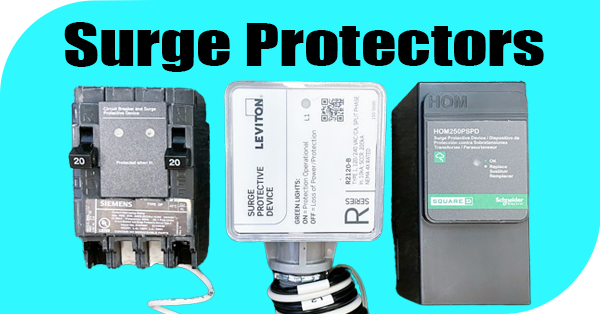
If You Have a Siemens or Murray Panel: Siemens QSA2020SPDP
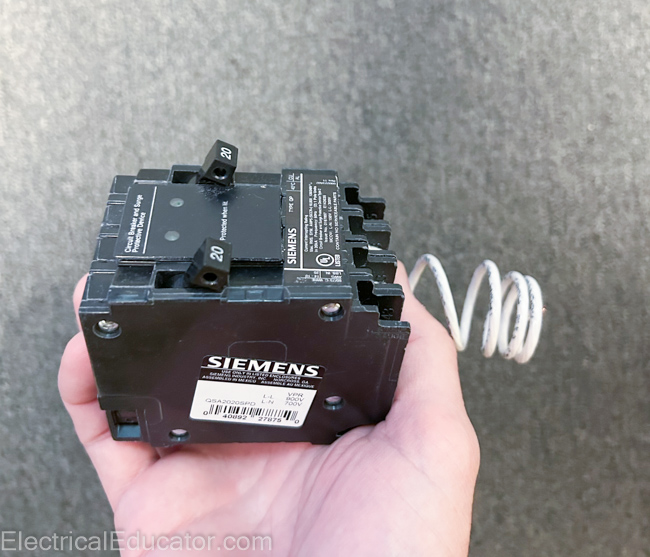
This is the unit I install most often these days.
It’s a Type 2 SPD built into a breaker-style housing designed for compatible Siemens load centers.
Certain Murray load centers may also accept Siemens replacement equipment, but compatibility should always be verified against the specific panel and manufacturer documentation.
The device occupies two panel spaces and incorporates two independent single-pole circuit breakers alongside the surge protective device.
Siemens offers 15-amp and 20-amp versions, allowing the device to replace two compatible existing branch-circuit breakers while also providing whole-house surge protection.
This leads to some confusion because it’s effectively doing both jobs in one device.
The major advantage is that you can add surge protection without necessarily sacrificing additional breaker spaces.
If You Have a Square D Panel (QO or Homeline): Square D QO250PSPD
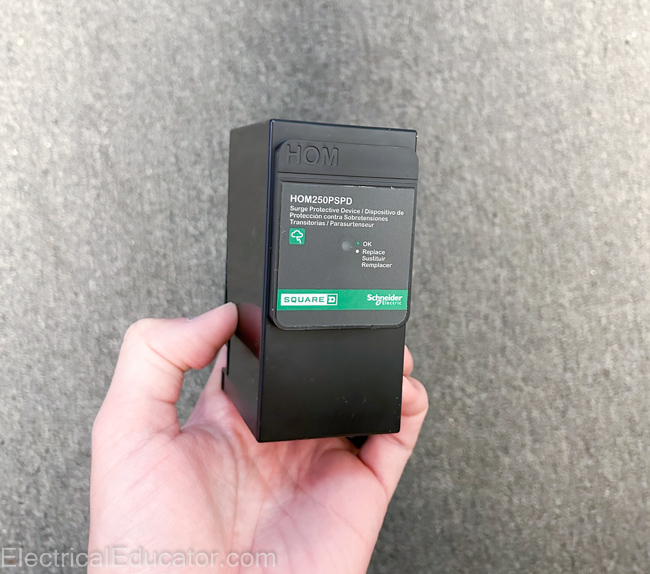
This is the link to the Homeline version
Here’s the link to the QO version (less common than the Homeline)
Square D offers plug-on surge protective devices designed specifically for its QO and Homeline load centers.
The QO250PSPD is designed for compatible QO equipment, while the HOM250PSPD is the corresponding option for compatible Homeline equipment.
These devices offer a compact way to add surge protection at the panel without installing a separate external enclosure.
One thing to flag: Square D’s breaker-style units are panel-family specific, not just brand-specific.
A QO panel needs an approved QO device, and a Homeline panel needs an approved Homeline device. Same trap as Siemens/Murray, just one level more specific.
If You Have Any Other Panel (or Want It Mounted Externally or Outside): Leviton R2120-B
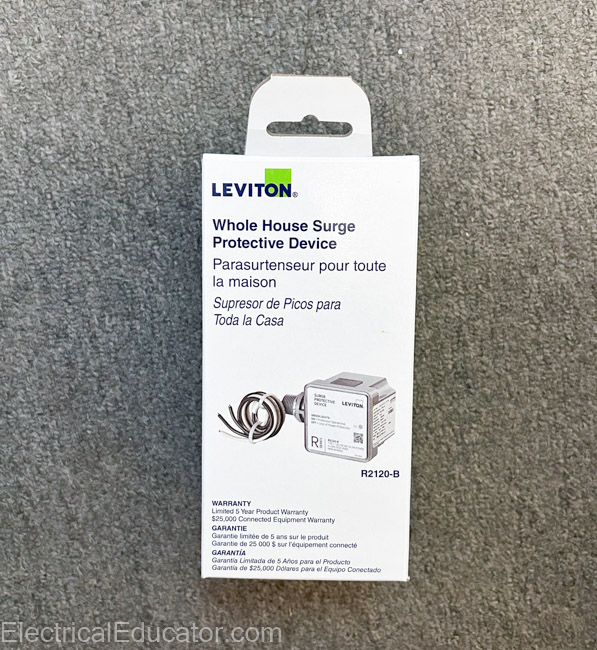
Here’s a link to the Leviton model
This is my go-to when the panel isn’t a compatible Siemens/Murray or Square D, or when there simply isn’t room inside the panel for a plug-on surge protective device.
It mounts externally in its own enclosure and connects to the electrical system using the manufacturer’s approved installation method.
The advantage of an externally mounted SPD is that it doesn’t depend on the same plug-on bus configuration as a panel-specific unit.
That doesn’t mean every external SPD is universally compatible, though. The device must still be suitable for the electrical system, installed with the required overcurrent protection where applicable, and connected according to its listing and instructions.
For outdoor installations, the enclosure must also be rated for the environment.
The Leviton R2120-B is worth considering for applications where an external SPD is the better fit. Verify the current manufacturer’s specifications, environmental rating, and installation requirements before purchasing.
| Your Panel | Recommended SPD | Style |
|---|---|---|
| Siemens or Murray | Siemens QSA2020SPDP | Plug-on breaker/SPD combination |
| Square D QO | Square D QO250PSPD | Plug-on breaker SPD |
| Square D Homeline | Square D HOM250PSPD | Plug-on breaker SPD |
| Anything else / no panel space | Leviton R2120-B | External, NEMA 4X enclosure |
(Worth noting: I’ve also specified and installed heavier-duty SPDs protecting industrial and CNC-type equipment, which operate on the same principles but at a completely different scale. That’s not gear I’d point a homeowner toward but it’s given me a good look at what a serious surge can do to equipment that’s supposed to be hardened against it.)
What Does It Cost?
In terms of cost, the units themselves are extraordinarily inexpensive for what they can actually do.
At the time of writing, the Siemens model was around $140, the Square D around $100, and the Leviton approximately $50. Prices vary by supplier, model, and availability.
Depending on where you live, professional installation may add approximately $200–$250 in a straightforward installation, provided the existing electrical equipment is suitable and no additional corrective work is necessary.
Actual costs will vary depending on the panel configuration, installation requirements, and local labor rates.
I encourage readers to use our National Electrical Registry if you don’t already have a relationship with a licensed electrician.
What Equipment Benefits Most from Surge Protection?
One of the most common reasons people call our office asking about whole-house surge protection has to do with HVAC equipment.
The variable-speed motors and electronic control boards in central air-conditioning systems, along with the electronics in mini-split units, can be particularly expensive to replace when damaged.
It doesn’t end there, though.
TVs, computers, refrigerators, home networking equipment, appliances, and just about anything today containing electronic circuitry can benefit from surge protection.
And that’s really the point. We’re no longer just protecting a handful of expensive electronics plugged into the wall. We’re protecting an entire home filled with equipment that relies on sensitive electronic components.
Frequently Asked Questions
Do I still need power strip surge protectors if I have a whole-house unit? Yes. A whole-house SPD is your first line of defense (Type 1/2); point-of-use power strips (Type 3) are still valuable, especially for particularly sensitive electronics like computers and home theater equipment. They work together, not instead of each other.
Will a whole-house surge protector protect against a direct lightning strike? No, no consumer-grade product will. A direct strike carries far more energy than any panel-mounted SPD is rated to fully absorb. What it will do is meaningfully reduce damage from the far more common events: nearby strikes, utility switching surges, and internally generated surges from your own major appliances cycling on and off.
Does insurance care if I have one installed? Some carriers offer small discounts, and it’s worth asking. More relevant: after a surge event, having a properly installed, code-compliant SPD can support a claim if a subsequent surge does cause damage.
Can I install this myself? Physically, the breaker-style units aren’t complicated but you’re working inside a live, energized panel. Let a licensed electrician handle it. It’s typically a short visit and ensures it’s actually protecting what it’s supposed to.
Mike Lombardo is a master electrician and the founder of Electrical Educator.